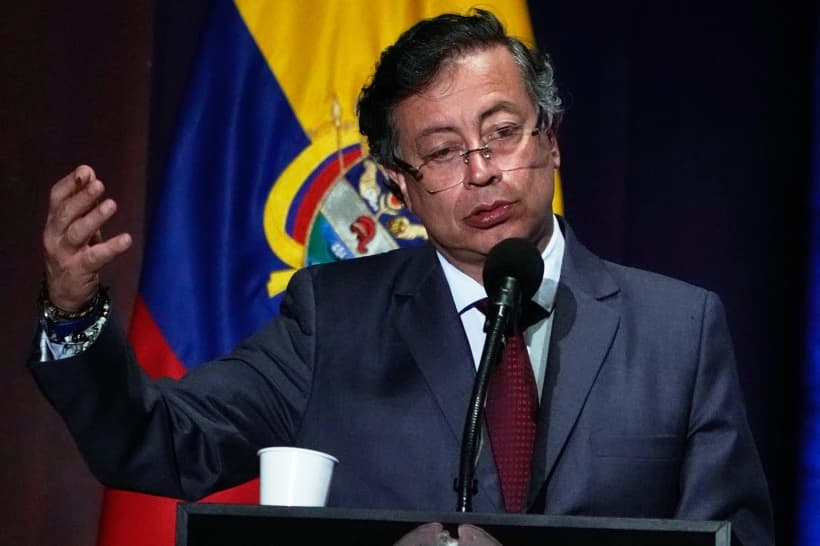
SÃO PAULO, Brazil – U.S. President Donald Trump on Sunday accused Colombia’s President Gustavo Petro of trafficking illegal narcotics and threatened military action against him, not two full days after the U.S. captured Venzuela’s president Nicolás Maduro in an nightime incursion between Friday and the small hours of Saturday.
“Colombia is very sick, too,” Trump told reporters aboard Air Force One on Sunday, “run by a sick man, who likes making cocaine and selling it to the United States, and he’s not going to be doing it very long.”
When reporters asked Trump to clarify whether he intended to threaten military action against Colombia like the action the U.S. took against Maduro, Trump said such an operation “sounds good to me.”
It was the second time in as many days Trump threatened Petro.
Only a few hours after the U.S. strikes in Venezuela and the seizure of leader Nicolas Maduro at the weekend, Trump threatened to take comparable measures against Colombia’s Petro, accusing him of producing and smuggling cocaine to the US.
Trump was asked about Petro during his Saturday press conference on Maduro’s abduction held at Mar-a-Lago. Trump said the Colombian president keeps “cocaine mills” and “factories” and is “sending it to the United States,” so Petro “does have to watch his ass.”
Trump’s remarks on Saturday and Sunday came after a long exchange of verbal hostilities between the two leaders over the past weeks, with Petro criticizing Trump for U.S. strikes against Venezuelan boats in the Caribbean, which were supposedly carrying drugs.
Trump responded, saying that Petro himself was an “illegal drug dealer” and could “be next.” While Colombia is historically a major producer of cocaine, Trump has not produced any evidence connecting Petro to such activity.
On Saturday, after the US operation in Venezuela, Petro condemned the U.S. action as “an aggression against the sovereignty of Venezuela and of Latin America.”
Petro said he is “not worried at all” after Trump’s threatening remark on Saturday.
Colombian Catholics have received the war of words between Trump and Petro with concern, especially the US president’s latest remarks.
In public opinion, the situation has been filtered through polarized political lenses, with most on the right expressing support for Trump and most on the left condemning the U.S. intervention.
, affirmed.
“The problem,” said Ignacio Madera, a theology professor at the Pontifical Xaverian University of Bogota, “is that the press, owned by large economic groups, has been presenting the U.S. operation as the triumph of liberty.”
He said many civic organizations and progressive sectors have been criticizing such views and the idea of Latin America representing the U.S. “backyard.”
Diego Arias, an expert in public security and armed conflicts, said many people expected Trump somehow to connect Colombia to the Venezuelan situation.
Arias said the main concern among most Colombians, however, is with the Venezuelan crisis itself.
“The theme of Venezuela being ruled by the US, the aspects connected to oil, and how the transition will be have been dominating the debate,” Arias told Crux.
Arias said Petro’s opponents have been disseminating memes on social media about Petro being abducted by the U.S., with pictures of him wearing an orange prison uniform and other satirical creations of that kind.
In the real world, a movement of Venezuelan immigrants preparing to go back to their country is already noticeable in cities like Bogota, Cali and Pasto, Arias also said.
Colombia hosts almost 3 million Venezuelan immigrants and refugees. Most of them arrived over the past decade, escaping the sociopolitical turmoil of Maduro’s Venezuela.
Trump’s strikes in Caracas and abduction of Maduro have been received with hope by many of such Venezuelans, Arias said.
“They seem to be confident that a real change will occur, with a reconstruction of the Venezuelan economy, the creation of jobs and so on. People are waiting for a transformation,” he said.
Arias, however, was not sure a transition will happen in the short term and without significant difficulty.
Bishop Juan Carlos Barreto of the Diocese of Soacha, who heads the Colombian Caritas, told Crux there is great concern over the U.S. president’s willingness to operate “without observing the principles of the United Nations and without consulting the US Congress.”
“That’s all evidence of his authoritarianism,” Barreto said.
Barreto said that, if the US action against Venezuela, “which is totally inadmissible, is expanded to Colombia, a country in which there’s a legitimately elected president, we’d see a much more serious aggression, one with terrible consequences.”
“I think we need to listen to the pope’s voice,” Barreto said. “Venezuela’s sovereignty must be respected,” he said, “the rule of law must be ensured, as well as the human and civil rights of everyone.”
Barreto said Venezuelans still fear the development of the political situation in their nation.
“Strong intervention by the international community in order to ensure peace and autonomy in Venezuela would be convenient,” the prelate also said.
Madera, however, doesn’t count on such a possibility, nor does he rule out an invasion of Colombia.
“Given the passivity of all countries and the ambiguities of many, everything is possible when it comes to the violent capitalist mind of Trump,” the professor said.